

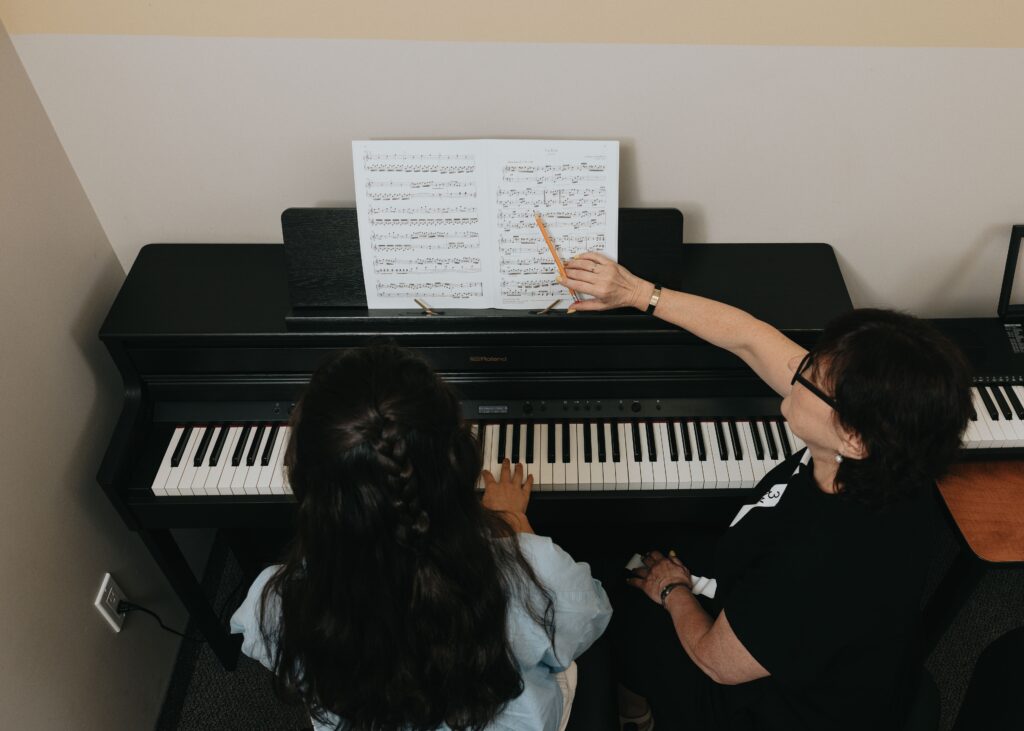
As a parent, you want to see your child succeed – not just in the classroom, but in all areas of life. One of the most effective (and often overlooked) ways to support that success is through music education. At The Piano Studio in Newmarket and Aurora, we’ve seen firsthand how music lessons improve math and focus in children, boost memory retention, and build cognitive skills that last far beyond the classroom. Music might be the missing link in helping your child reach their full academic potential.
1. Music Strengthens Math Skills
You may not realize it, but music and math are deeply connected. When your child learns rhythm, note values, time signatures, and scales, they’re actually working with fractions, patterns, and ratios.[¹]
Here’s how it works:
- Reading music = math in action: Understanding a quarter note versus an eighth note requires the same kind of logic used in solving math problems.
- Rhythmic counting boosts sequencing: Counting beats (1-2-3-4) helps children grasp patterns and predictability – critical skills in math.[²]
- Piano scales reinforce numerical order: Playing scales strengthens a child’s understanding of spatial relationships and number sequences.
Data suggests a strong link between music education and improved math performance in students.[³] And they’re not just memorizing answers – they’re thinking differently.
2. Music Boosts Memory and Retention
Ever wonder how your child can remember every lyric of a song after hearing it once – yet can’t recall what you just asked them to do a moment ago? Music engages the brain’s memory systems in powerful ways.[⁴]
How music training sharpens memory:
- Students memorize notes, finger placements, and entire songs – all while reading ahead and playing in real time.
- Sight-reading and ear training challenge short-term and working memory, helping kids retain information longer.[⁵]
- Practice builds long-term memory: The repetition of daily practice wires the brain for better information storage.[⁶]
In fact, research shows that music students often have better verbal memory, meaning they can retain words, instructions, and spoken information more effectively.[⁷]
3. Music Lessons Build Focus and Discipline
Distractions are everywhere – from screens to notifications – and it’s getting harder for kids to concentrate. Music lessons offer a rare opportunity to slow down, tune in, and build real mental discipline.
Music lessons demand the opposite of distraction: concentration, patience, and consistent effort – qualities every parent wants to instill.
Focus-building benefits of music:
- Attention to detail: Learning a piece of music requires noticing dynamics, timing, and subtle shifts – which improves concentration over time.
- Daily practice routines foster discipline and goal-setting habits.
- Delayed gratification: Learning music isn’t instant. Students must work through challenges before seeing results, which builds resilience.
Teachers at The Piano Studio consistently see students who struggle to focus in school become calmer and more centered after committing to music lessons. It happens gradually, but the results are undeniable – and research backs it up.[⁸]
4. Music Activates the Whole Brain
What makes music such a unique cognitive tool is how much of the brain it engages. When a child plays piano or guitar, they’re using:
- Left brain (logic + sequencing)
- Right brain (creativity + emotion)
- Motor cortex (hands, eyes, body coordination)
- Auditory system (listening + pitch)
- Memory centers (short + long term)
Very few activities light up the brain the way music does. Studies using MRI scans show that music activates nearly every region of the brain simultaneously, enhancing connections between hemispheres and improving communication across neural networks.[⁹]
This is why many neuroscientists recommend introducing music education as early as age 4 or 5 – and why it supports development in reading, language, and social-emotional learning.[¹⁰]
Real Results, Real Families – Right Here in Newmarket and Aurora
At The Piano Studio, we’ve seen hundreds of students across Newmarket and Aurora develop stronger academic performance after starting lessons. Parents often tell us:
“He’s more focused in school now.”
“Her memory and confidence have totally changed.”
“Math homework isn’t a fight anymore!”
Whether your child is just starting school or preparing for high school, music lessons can help shape the way they think, learn, and grow – for life.
Ready to Build More Than Just Musical Skills?
If you’re looking for a proven way to help your child sharpen their focus, boost their memory, and strengthen math skills – music might be the missing piece.
At The Piano Studio, we offer private music lessons for kids of all ages, taught by passionate, qualified instructors who know how to make learning fun and effective.
References
- Geoghegan, N. & Mitchelmore, M. (1996). Possible Effects of Early Childhood Music on Mathematical Achievement. Journal for Australian Research in Early Childhood Education.
- Gordon, E. (2003). Learning Sequences in Music: Skill, Content, and Patterns. GIA Publications.
- Vaughn, K. (2000). Music and Mathematics: Modest Support for the Oft-Claimed Relationship. Journal of Aesthetic Education.
- Hallam, S. (2010). The Power of Music: Its Impact on the Intellectual, Social and Personal Development of Children and Young People. International Journal of Music Education.
- Ho, Y.C., Cheung, M.C., & Chan, A.S. (2003). Music training improves verbal but not visual memory: Cross-sectional and longitudinal explorations in children. Neuropsychology.
- Schlaug, G. et al. (2005). Training-induced neuroplasticity in young children. Annals of the New York Academy of Sciences.
- Chan, A.S., Ho, Y.C., & Cheung, M.C. (1998). Music training improves verbal memory. Nature.
- Schellenberg, E.G. (2004). Music lessons enhance IQ. Psychological Science.
- Levitin, D. (2006). This Is Your Brain on Music: The Science of a Human Obsession. Dutton/Penguin.
- Habibi, A. et al. (2018). Neural correlates of accelerated auditory processing in children engaged in music training. Developmental Cognitive Neuroscience.